
Welcome to Nex Gen Publications
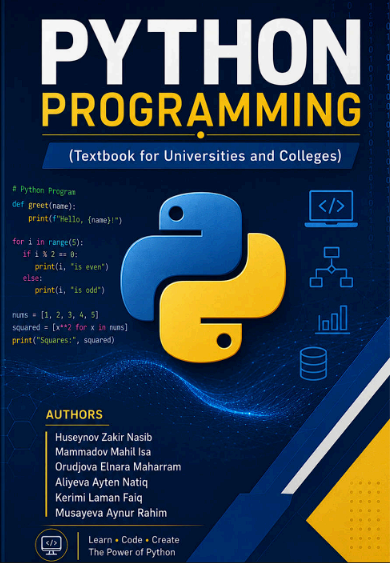
PYTHON PROGRAMMING
Huseynov Zakir Nasib, Mammadov Mahil İsa, Orudjova Elnara Maharram, Aliyeva Ayten Natiq, Kerimi Laman Faiq qızı and Musayeva Aynur Rahi
Format
Paperback and e – book
ISBN
978-81-69295-10-9
DOI
doi.org/10.5281/zenodo.21405618
Pages
415 Pages
Price
Rs. 999/- ( $80 )
Programming has become one of the fundamental skills required in modern science, engineering, education, agriculture, business, and technology. The ability to design an algorithm, describe a problem formally, process data, and obtain a reliable result is no longer limited to computer specialists. It is now an essential competence for students and professionals in many fields. For this reason, the study of programming must begin with clear theoretical foundations and continue through practical examples, structured exercises, and independent problem solving. This textbook, Python Programming, has been prepared for students of universities and colleges who study Computer Engineering, Information Technology, Information Systems, Computer Science, and related specialties. It may also be useful for master’s students, doctoral students, instructors, specialists, and independent learners who wish to develop practical programming skills using Python. The main purpose of the textbook is to introduce programming not only as the writing of source code, but also as a systematic method of thinking. A correctly written program begins with a correctly formulated problem. Therefore, special attention is given to problem formulation, input data, constraints, expected results, algorithmic thinking, and verification of correctness. This approach helps students understand why a program is written in a particular way and how each instruction contributes to the final result. Python has been selected as the main programming language because of its readable syntax, wide practical application, and strong educational value. Its simple structure allows beginners to focus on the logic of programming before dealing with more complex technical details. At the same time, Python is powerful enough for data processing, automation, object-oriented programming, testing, and project development. The textbook presents the topics in a gradual and logical sequence. It begins with the stages of solving problems on a computer and the concept of an algorithm. It then explains the Python programming environment, syntax rules, variables, data types, operators, conditional statements, loops, functions, collections, file handling, exceptions, and error analysis. Later chapters introduce object-oriented programming, classes and objects, inheritance, polymorphism, packages, virtual environments, project-folder organization, initial Git practices, testing, and final project development. A distinctive feature of this textbook is its emphasis on the connection between theory and practice. Each topic is supported by explanations, sample programs, step-by-step comments, tables, diagrams, self-check questions, and independent assignments. These elements are intended to help students move from passive reading to active problem solving. The examples are written in a form suitable for classroom teaching, laboratory work, and independent study. The textbook also encourages students to develop programming culture. A program should not merely run; it should solve the given problem correctly, handle data properly, follow a clear algorithm, and produce a verifiable result. For this reason, testing, debugging, error analysis, and correctness checking are treated as important parts of the learning process. The authors hope that this textbook will help students acquire a solid foundation in programming, develop algorithmic thinking, and gain confidence in writing applied programs in Python. The material has been prepared with the aim of supporting both theoretical understanding and practical competence. It is expected that readers will use the knowledge gained from this book in academic work, professional activity, and future software development projects. The authors express their gratitude to the reviewers, colleagues, and students whose observations and academic support contributed to the preparation of this textbook. Constructive comments and suggestions from readers will be appreciated and may be considered in future editions.
-
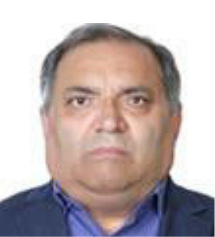
Mammadov Mahil Isa PhD in Engineering, Associate Professor. Born on May 1, 1966, in Agdam village, Tovuz district. In 1990, he graduated from the Azerbaijan Polytechnic Institute (now Azerbaijan Technical University) with a degree in Electronic Computing Machines. On September 20, 2013, he defended his dissertation on “Improvement of the technology for preparing information-software-based feed pellets” and was awarded the degree of Doctor of Philosophy in Engineering in the specialty 3102.01 – Agroengineering. In 2017, he received the academic title of Associate Professor in the Department of Information Technologies. 1990–1994: Engineerprogrammer at the Azerbaijan Agricultural Institute. 1994–2009: Leading specialist-programmer at the Ganja branch of the Azerbaijan Joint-Stock Commercial Bank. 2009–2017: Lecturer and Senior Lecturer at the Department of Information Technologies, Azerbaijan State Agrarian University.2017–pr sent: Associate Professor at the same department.
-

Orucova Elnarə Məhərrəm PhD in Pedagogy, Senior Lecturer.Was born on May 31, 1980.In 2002, she completed her bachelor's degree in Mathematics at Ganja State University, and in 2004, she completed her master's degree in Computer Science. He was awarded the degree of Doctor of Philosophy in Pedagogy by the decision of the Higher Attestation Commission Collegium dated 18.02.2026. He worked as a research associate at the Ganja branch of the Azerbaijan National Academy of Sciences from 18.01.2015 to 15.09.2018.Currently, he/she works as an associate professor in the Department of Information Technologies at Azerbaijan State Agrarian University.
-

Aliyeva Ayten Natiq Senior Lecturer. Was born on December 1, 1992. In 2014, he completed his bachelor's degree in "Mathematics and Computer Science Teaching" at Ganja State University, and in 2016, he completed his master's degree in "Information Systems in Management" at Azerbaijan State Agrarian University. From 2016 to 2025, he worked as an assistant in the Department of Information Technologies at Azerbaijan State Agrarian University. Since July 5, 2025, he has been working as an associate professor in the same department.
-

Kerimi Laman Faiq Teacher, Assistant.Was born on October 19, 1995. In 2017, he completed his bachelor's degree in "Mathematics and Computer Science Teaching" at Ganja State University, and in 2019, he completed his master's degree in "Information Systems in Management" at Azerbaijan State Agrarian University. In 2020, he was admitted to the doctoral program in "Agroengineering" at Azerbaijan State Agrarian University. Since 2020, he has been working as a lecturer in the Department of Information Technologies at the Azerbaijan State Agrarian University.
-

Musayeva Aynur Rahim Teacher, Assistant .Was born on September 27, 1990. In 2012, she completed her bachelor's degree in Mathematics and Computer Science at Ganja State University, and in 2020, she completed her master's degree in Computer Science at Ganja State University.Since 2021, he has been working as a teacher in the Department of Information Technologies at Azerbaijan State Agrarian University.
Huseynov Zakir Nasib PhD in Engineering, Associate Professor. Was born 02 July 1955. In 1980 graduated from Kirovabad state pedagogical institute after named h. Zardabi, mathematic faculty. By the decree of the president of the republic of Azerbaijan dated 03.10.2006, he was awarded the honorary title "honored teacher of the republic". In 2012 he defended his dissertation on "research of performance indicators of priority service telecommunication networks" and received the degree of doctor of philosophy in technique. From November 2020 he is the head of the information Technologies Department of Azerbaijan State Agricultural University.