
Welcome to Nex Gen Publications
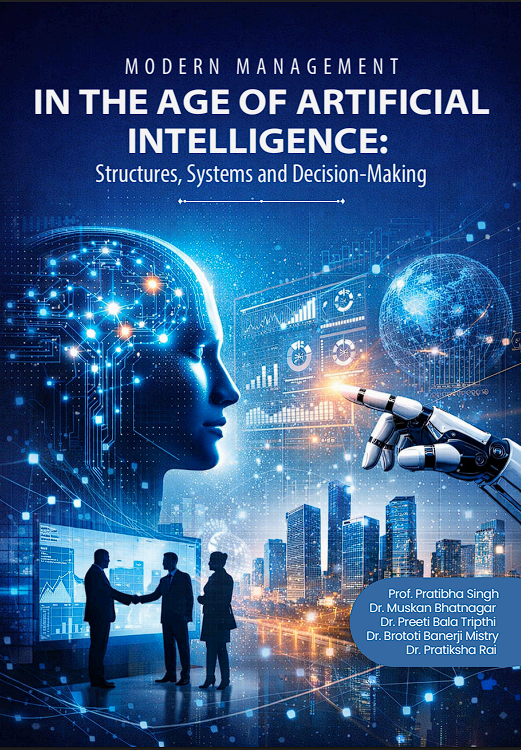
Modern Management in the Age of Artificial Intelligence: Structures, Systems and Decision-Making
Prof. Pratibha Singh, Dr. Muskan Bhatnagar, Dr. Preeti Bala Tripthi, Dr. Brototi Banerji Mistry and Dr. Pratiksha Rai
Format
Paperback and e – book
ISBN
978-81-19477-35-7
Pages
144 Pages
Price
Rs. 1000/- ( $80 )
Management as a discipline has evolved continuously in response to changes in economic conditions, technological innovation, and organizational needs. In the twenty-first century, one of the most influential forces transforming management practices is artificial intelligence (AI). The rapid development of AI technologies has significantly altered how organizations operate, make decisions, and structure their internal systems. As businesses increasingly rely on data-driven insights, automation, and intelligent algorithms, managers must adapt their approaches to remain effective in this dynamic environment. Modern Management in the Age of Artificial Intelligence: Structures, Systems and Decision-Making aims to explore how traditional management principles are being reshaped by the integration of artificial intelligence into organizational processes. While the fundamental functions of management—planning, organizing, leading, and controlling—remain essential, the tools and systems used to carry out these functions have changed dramatically. AI technologies enable organizations to analyze vast amounts of data, improve operational efficiency, enhance forecasting accuracy, and support strategic decision-making. This book examines the relationship between management theory and technological innovation. It discusses how artificial intelligence is influencing organizational structures, managerial systems, and decision-making processes across different sectors. The integration of AI in management not only creates opportunities for increased productivity and innovation but also raises important concerns related to ethics, accountability, workforce transformation, and the role of human judgment. A key idea emphasized throughout this book is that artificial intelligence should be viewed as a tool that complements, rather than replaces, human managerial capabilities. Effective management in the AI era requires a balance between technological expertise and human insight, creativity, and leadership. This book is intended for students, researchers, and professionals interested in understanding the evolving nature of management in a technologically advanced world. By examining both theoretical perspectives and practical implications, it seeks to provide a comprehensive understanding of how organizations can successfully navigate management in the age of artificial intelligence.
Prof. Pratibha Singhis a passionate educator, researcher, and HR professional dedicated to shaping ethical and future-ready organizations. With over thirteen years of rich experience across academia and industry, she serves as a Visiting Assistant Professor of Human Resource Management and Labour Welfare at leading management institutions in Pune. Currently pursuing her Ph.D. from Integral University, her research explores the transformative role of Human Resource Information Systems and Work–Life Balance in the digital era. Having served as an HR Business Partner with renowned organizations including Reliance Industries Limited, she brings real-world insight to academic thought. Her work champions employee dignity, engagement, and AI-driven management practices—bridging knowledge with purpose and inspiring responsible leadership for tomorrow’s workplaces.
Dr. Muskan Bhatnagar is an Assistant Professor at Jaipuria Institute of Management, Ghaziabad, India. She holds a Ph.D. in Commerce from Amity University, Noida, where her doctoral research focused on cyber frauds in e-commerce transactions and the antecedents of trust in digital financial environments. Her academic expertise lies at the intersection of finance, cybersecurity, and consumer behaviour in technology-driven markets. Dr. Bhatnagar’s research primarily examines emerging cyber risks in digital financial transactions, consumer trust in e-commerce platforms, and cyber risk protection mechanisms. She has published scholarly research in Scopus-indexed journals and has presented her work at national and international conferences. Her research integrates financial decision-making frameworks with cybersecurity awareness, contributing to the understanding of cyber fraud prevention and digital risk mitigation in online financial ecosystems. In addition to her research contributions, she actively engages in.
Dr. Preeti Bala Tripthi Is working As an Associate professor at the Institute of Management Studies (University Courses Campus), she has more than 12 years of teaching experience at different national and international universities. Apart from that, she is also working as a consultant at the London School of International Business.She is also associated as a SME at Galoden Gate University with an upgrade.
Dr. Brototi Sanjay Mistry Ph.D. Doctorate /MBA HRM/ M. Com /IRDA Licentiate/IIT Course Certified /All India Accredited Management Teacher/ 18 Years of Working Experience in Service, Manufacturing and Academics, more than 15 Research Papers Published in UGC –Care Journal in ABDC Journal & in Scopus Journal.
Corporate Work Experience: 5 years
Achievement: Rewarded with best excellence certificate for performance
Dr. Pratiksha Rai is an academician and researcher in the field of Commerce and Marketing. She holds a B.Com and M.Com degree and earned her Ph.D. from the Faculty of Commerce, Banaras Hindu University (BHU). She also qualified the UGC NET in December 2018.
Dr. Pratiksha Rai is currently serving as an Assistant Professor in Marketing at the Pune Institute of Business Management. Her academic interests include marketing management, business research, and contemporary developments in commerce education. She is actively involved in teaching, research, and academic mentoring, contributing to the development of future business professionals.